
I review things for a living, more or less, and if you handed me a research peptide website as a “product” to grade, here’s my first note in the margin: nice packaging, no seatbelt. That’s the whole review, really. Everything else is just me explaining why.
So you’ve been Googling “Limitless Life alternatives.” Fair enough, I’ve been down that same search hole. But I want to pull you back from the actual question you’re asking, because it’s the wrong one. You’re shopping for a nicer vial. The vial was never the problem. The vial is the last decision in this whole process, and somehow it’s the one everyone rushes to first.


Let me grade this the way I’d grade anything else: what’s being sold on the label, what it actually delivers, and what would make me trust it. Three categories. Let’s go.
Category one: the hype
Limitless Life Nootropics, also trading as Limitless Biotech, is a real Florida outfit that’s been around since 2019. Big catalog, something like ninety peptides across injectables, capsules, nasal sprays. The greatest hits are all there: BPC-157, TB-500, ipamorelin, CJC-1295, sermorelin, selank, semax, epitalon. They say they run HPLC and LC-MS testing on every batch and that certificates exist, though they don’t name who’s actually running the tests, and the customer reviews online land somewhere between “changed my life” and “shrug.” Standard stuff for the category.
Here’s my actual review of that pitch: it doesn’t matter. Not because the company is uniquely bad, but because the entire genre it operates in is built the same way, and the genre is the story, not the storefront.
Every product page carries two phrases: “for research use only” and “not for human consumption.” New shoppers read that as boilerplate. It’s not boilerplate. It’s a disclosure. It’s the seller telling you, in writing, that nobody there is checking your health history, nobody is deciding whether this is a good idea for your body, and there’s no prescription anywhere in the chain. Box ships, relationship ends, and whatever happens after that is entirely yours to deal with.
That’s not a knock unique to Limitless Life. Core Peptides, Swiss Chems, Biotech Peptides, Pure Rawz, Amino Asylum, Sports Technology Labs, they’re all running the identical machine: a molecule arrives in the mail with a disclaimer stapled to it, and no clinician has ever laid eyes on you. Ranking these against each other is like grading rooms with no lights on how tidy they look in the dark. You genuinely cannot tell.
Hype grade: C-. Confident catalog, confident language, zero accountability baked into the actual transaction.
Category two: what actually earns trust
If the research-chemical route is the thing to avoid, what’s the alternative that isn’t just a shinier version of the same problem?
It’s not a nicer vial. It’s a completely different transaction: a licensed clinician looks at you first, writes an actual prescription, and a licensed compounding pharmacy makes the thing under real standards and ships it. You’re not trading up in packaging. You’re trading “a chemical mailed to a stranger” for “a clinician, a pharmacy, a prescription, and someone to call if something feels off.”
FormBlends is the cleanest example I’ve found of that model, and it’s the one I’d point a first-timer toward. It’s upfront that it’s a platform, not a medical practice, and doesn’t write prescriptions or dispense medical advice itself. In its own words, clinical services “are provided by independent, licensed healthcare providers,” and “all medications require a licensed physician consultation and prescription.” When something is appropriate, a licensed 503A compounding pharmacy prepares it, with per-batch testing like HPLC for purity and mass spec to confirm identity. HealthRX.com runs the same supervised structure as a second option, leaning more toward GLP-1 access specifically.
I’m not going to oversell this, because that would make me exactly the kind of source this whole piece is warning you about. Going the supervised route doesn’t make a peptide magically approved, and it doesn’t turn thin animal data into a slam-dunk human trial. What it buys you is the one thing a research-chemical order structurally cannot include: a qualified person deciding whether this makes sense for you, a licensed pharmacy on the hook for what’s actually in the bottle, and somewhere to go if it doesn’t work out. The cost is friction, an intake form, a clinician who has to actually agree. That friction isn’t a flaw in the system. As a beginner, it’s the entire feature you’re paying for.
Trust grade: B+. Not magic, not FDA approval by association, but a real chain of accountability that the research-chemical model simply does not have.
The science, reviewed honestly
Before you spend a cent, you should know that “peptides” isn’t one product category, it’s at least three, and the marketing loves to blur them together.
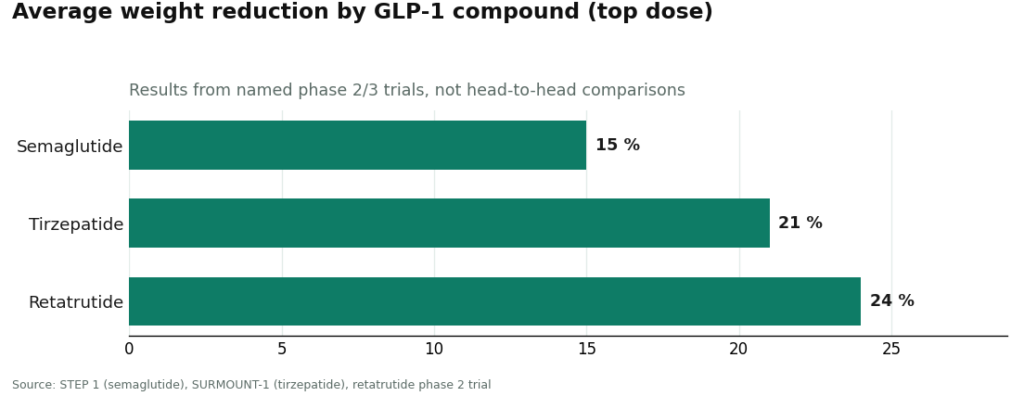
The GLP-1s are the real deal, and I’ll say so plainly. Semaglutide and tirzepatide have serious large-trial evidence. In STEP 1, once-weekly semaglutide produced roughly a 15 percent average body-weight reduction over 68 weeks [C6]. Tirzepatide beat that in SURMOUNT-1, with the top dose landing around 21 percent [C7]. A newer triple-receptor compound, retatrutide, hit about 24 percent at its highest dose in a phase 2 trial [C8]. Genuinely strong data. But it’s evidence for the studied, approved products taken under medical supervision, not for an unlabeled research vial that happens to share a name.
A handful of peptides have real, narrow, FDA-approved uses. PT-141, or bremelanotide, is the honest example. It’s approved, sold as Vyleesi, for one specific thing: low sexual desire in premenopausal women, backed by two randomized phase 3 trials [C9]. Real approval, narrow lane. It doesn’t stretch to cover whatever else the catalog pages claim it does.
And then there’s the bucket where most of the actual catalog lives: recovery, anti-aging, general wellness. BPC-157 headlines every one of these stores. The science is interesting, genuinely, but it’s almost entirely preclinical. A 2026 review in Pharmaceuticals lays out proposed protective mechanisms in animal injury models [C10], which is a fair summary of where things sit: animal data and hypotheses, not human trials showing it fixes tendons in people. Same story with NAD+ and its precursors. The human data that exists is small and tied to specific conditions, like a double-blind crossover trial of nicotinamide riboside in patients with Werner syndrome [C11], not proof that it slows aging in a healthy adult.
If I had to give you one rule to remember, it’s this, and it’s almost the opposite of what the marketing implies: the compounds shouting “clinically proven” loudest on the sales page tend to have the thinnest trials behind them, while the genuinely strong evidence barely needs the hype. So when a store sounds most certain, that’s often your cue to trust it least.
Science grade: varies wildly by molecule, which is exactly the point. Don’t let one glowing paragraph about GLP-1s launder the BPC-157 pitch next to it.
What actually earns the checkmark
You don’t need a scorecard with twelve categories. You need five yes-or-no questions, and you can run them against Limitless Life or literally anything else you find.
Did a licensed clinician review your intake and write a real prescription? If checkout is the entire process with no doctor anywhere, you’re buying a research chemical no matter how the site is dressed up. Weight this one heaviest.
Is a named, licensed pharmacy doing the preparation? A 503A or 503B pharmacy operates inside a legal framework and answers for what’s in the bottle. A “lab” mailing you a vial answers to nobody.
Can you see the testing, and do you know who ran it? Published purity and identity data beats a label. An unnamed lab’s certificate is weaker than per-batch numbers from a pharmacy that has to stand behind its own name.
Will the provider say out loud that compounded medicine isn’t FDA-approved? A source honest about the boring, unglamorous limits is more trustworthy than one selling you certainty.
Is there any follow-up after the sale? Given how thin some of this evidence is, your own experience over time matters, and a provider who checks back in beats one that goes silent the moment your card clears.
Notice what didn’t make the list: price, shipping speed, how confident the website sounds. Beginners overweight all three, and none of them tell you whether what’s in the vial is safe, real, or legal. The cheapest, fastest, best-copywritten store can still mail you something mislabeled.
The questions you’re already asking
Is Limitless Life Nootropics a scam? No, and I won’t pretend otherwise for a punchier review. It’s a real business, and it publishes more testing documentation than a lot of its peers. What it isn’t is a supervised medical provider. No clinician, no prescription, products labeled “research use only” and “not for human consumption.” So the real question isn’t whether the company is honest. It’s whether you want a doctor and a licensed pharmacy in the loop before this goes in your body. For a beginner, the answer is almost always yes.
Is it even legal to buy from a research-use site in 2026? This is the part that genuinely shifted. On March 31, 2026, the FDA sent warning letters to a batch of online peptide sellers, including Gram Peptides and Prime Sciences, calling their products unapproved new drugs and rejecting the research-use label outright, stating that “evidence obtained from your website establishes that your products are intended to be drugs for human use” [C1]. That followed a wave of more than fifty similar letters in September 2025 covering compounded GLP-1 marketing and research-labeled peptides where the ads gave away the human-use intent [C2]. The disclaimer that was supposed to make this a quiet, low-risk purchase doesn’t even protect the seller anymore. It was never going to protect you.
Does the supervised route mean the peptide is FDA-approved? No, and any honest provider tells you so upfront. Sections 503A and 503B allow licensed pharmacies and physicians to compound medicine from a valid prescription outside the standard approval pipeline, under specific rules. That’s a real thing, and it’s a different thing from approval. The value of a supervised provider isn’t a claim of approval. It’s the clinician, the licensed pharmacy, the prescription, and the follow-up, none of which exist in a research-chemical order.
Just tell me the first move. Start with a supervised provider, not a research-chemical store, and let a clinician decide whether any of this is right for you before a needle gets involved. FormBlends is where I’d send a total beginner, HealthRX.com as a solid second, because both put a licensed clinician and a licensed pharmacy between you and the vial. That’s genuinely the whole move.
My final grade
Here’s the review, compressed. As a beginner, the vial is the last thing worth your attention, not the first. The molecule almost never the real question. The route is. A research-chemical store hands you the chemical and disappears. A supervised provider wraps a clinician, a pharmacy, a prescription, and a follow-up around that same molecule, which is a smaller promise than the marketing makes but a much more honest one.
If you’re stepping into this at all, walk in through the front door. Let a qualified person actually look at you first. That’s not red tape slowing you down for no reason. For someone starting from zero, that’s the whole point of the exercise.
Is Limitless Life Nootropics legit, or is it a scam?
It’s operating in a legal gray zone that puts the risk entirely on the buyer. Limitless Life sells research chemicals, meaning compounds not approved for human use, with essentially nobody accountable if something goes wrong. That’s not a scam in the classic sense, more a setup where you carry all the risk and they carry none. Slapping “for research purposes only” on the label doesn’t make the vial any safer once it’s actually in your body.
What are the best alternatives to Limitless Life Nootropics for someone who actually wants results?
Depends what you’re chasing. For cognitive support, boring old evidence-backed stuff like creatine, caffeine paired with L-theanine, and actual sleep hygiene has more human data behind it than most research peptides ever will. If you’re specifically after a compounded peptide or hormone protocol, a physician-supervised pharmacy like FormBlends gives you medical oversight, tested dosing, and someone legally on the hook for what’s in the vial.
What do real Limitless Life Nootropics reviews actually tell you?
Most glowing reviews describe a feeling, and feelings are notoriously hard to evaluate without a control group. Placebo response to anything you inject or swallow while expecting a result is strong and well documented. The negative reviews cluster around product quality and customer service once something goes sideways. Neither camp tells you whether the compound is safe long term, because for most of this catalog, that data just doesn’t exist yet.
Where should I buy peptides or nootropics instead of Limitless Life Nootropics?
Start by asking whether you actually need a prescription product at all. If a licensed clinician reviews your labs and agrees a specific compound makes sense, a registered compounding pharmacy is the correct channel, full stop. If you’re browsing research-chemical sites because a forum told you to, treat that as your cue to slow down. The vial really is the last decision here, not the first.
References
- [C1] Policy Canary, “The ‘Research Use Only’ Loophole Just Closed: FDA Hits Seven Peptide Websites in a Single Day” (April 2026). Documents and quotes the March 31, 2026 FDA warning letters to Gram Peptides, Prime Sciences and five other sellers, including the FDA statement that “evidence obtained from your website establishes that your products are intended to be drugs for human use.”
- [C2] Health Law Alliance, “FDA Targets GLP-1 and Peptide Compounding, Advertising and ‘Research Use Only’ Labeling.” Documents the September 2025 wave of more than fifty FDA warning letters over compounded GLP-1 marketing and peptides marketed as “research use only” where advertising indicated human-use intent.
- [C6] Wilding JPH, et al. “Once-Weekly Semaglutide in Adults with Overweight or Obesity.” New England Journal of Medicine, 2021;384:989-1002 (STEP 1 trial). https://pubmed.ncbi.nlm.nih.gov/33567185/
- [C7] Jastreboff AM, et al. “Tirzepatide Once Weekly for the Treatment of Obesity.” New England Journal of Medicine, 2022;387:205-216 (SURMOUNT-1 trial). https://pubmed.ncbi.nlm.nih.gov/35658024/
- [C8] Jastreboff AM, et al. “Triple-Hormone-Receptor Agonist Retatrutide for Obesity, A Phase 2 Trial.” New England Journal of Medicine, 2023;389:514-526.
- [C9] Kingsberg SA, et al. “Bremelanotide for the Treatment of Hypoactive Sexual Desire Disorder: Two Randomized Phase 3 Trials.” Obstetrics & Gynecology, 2019;134:899-908 (basis for the approved product Vyleesi).
- [C10] Sikiric P, et al. “Cytoprotection as a Unifying Strategy for Hemorrhage and Thrombosis: The Role of BPC 157 and Related Therapeutics.” Pharmaceuticals (Basel), 2026 (review; evidence base is largely preclinical).
- [C11] Shoji M, et al. “Nicotinamide Riboside Supplementation Benefits in Patients With Werner Syndrome: A Double-Blind Randomized Crossover Placebo-Controlled Trial.” Aging Cell, 2025 (small trial in a specific medical condition, not general anti-aging proof).
Written by Dario Turner, reporting fellow. Reporting from the sources cited above. Last reviewed April 2026.
For background only. Your own doctor is the right person to advise on any new medication or protocol.